
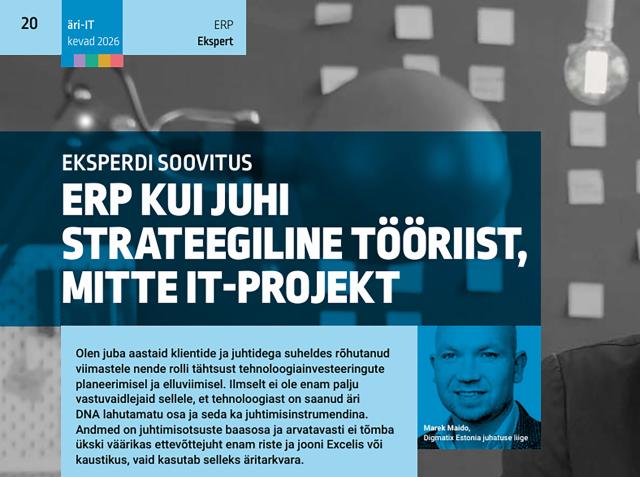
ERP as a Manager’s strategic tool, not an IT project
A new article by our colleague from Digmatix Estonia, Marek Maido, has been published in Business IT Magazine (Äri IT), Spring 2026, on the topic: ERP as a manager’s strategic tool, not an it project , which you can read below.
Author: Marek Maido
Digmatix Estonia board member
Source: Business IT Magazine (Äri IT) 2026 Spring
For years, when communicating with clients and managers, I have emphasized to the latter the importance of their role in planning and implementing technology investments. There are probably no longer many who would argue against the fact that technology has become an integral part of business DNA, including as a management instrument. Data is a fundamental part of management decisions, and probably no respectable business leader draws crosses and lines in Excel or in a notebook anymore, but instead uses business software for this purpose.
At the same time, one of the main reasons why large ERP projects fail is precisely the insufficient involvement of managers in the selection of the solution and its later implementation. Technology must support the company’s strategy, the execution of which relies on well-thought-out processes managed through software. Who decides on the company’s strategy and goals? Top executives. Who manage the processes? Middle managers. If any of them fail to contribute their best knowledge and attention to the implementation, there is a risk that important issues and needs will not reach the implementation partner and therefore will not be reflected in the new solution either.
The Road to Failure
According to Gartner, ERP implementations mainly fail due to the lack of a strategic perspective and project planning.
Main Reasons
- Insufficient management involvement: when managers lack a strategic perspective, this increases the risk that the scope of the ERP solution will be insufficient for the company. For example, investments may be made in the wrong functionalities or unsuitable customizations.
- Inadequate change management and communication: for example, department managers may resist changes because they do not understand their benefits, which in turn disrupts the implementation process and undermines cooperation with the implementation partner. At a later stage, end users may fail to adopt the new solution because management has not explained the objectives sufficiently.
- Ineffective integration planning: without the strategic perspective of managers, parts of the ERP system may operate in isolation. For example, if the finance department does not have access to sales data, financial reporting becomes inaccurate and decision-making deteriorates.
- • Misalignment with the company’s growth model: failing to align ERP selection with growth plans may result in future capability problems and wasted investment. During the selection process, the focus is placed not on future perspectives and developments, but rather on the budget and today’s needs. As a result, the company may face difficulties integrating new units and processes, which in turn leads to process fragmentation, while the demands of organic growth may overload the ERP system’s capabilities.
ERP as a Strategic Tool for Managers and the Company
ERP is not an IT project or software that simply automates processes. ERP is a strategic instrument that helps managers achieve the organization’s long-term goals, increase competitiveness, and support data-driven decision-making. This means that investment decisions should be based on business strategy, not on the need for a system. The role of an integrated information system is to serve as a business-strategic tool, not as a component of IT architecture.
In order to assess the impact of ERP systems, it is important to understand the company’s decision-making processes. This is a complex activity that requires data, timely information, and coordinated efforts between different departments. The process includes both strategic decisions that shape the company’s future and everyday operational activities. that affect operational performance. This is precisely where the role of ERP systems becomes crucial and where the input and contribution of managers are irreplaceable.
Why should ERP-related decisions be driven by business strategy rather than only by system requirements?
The success of an ERP project largely depends on how well it is aligned with the organization’s strategy. If an ERP system is selected solely on the basis of technical needs or functionality, the system may work technically, but this does not guarantee strategic impact, such as greater growth, improved quality, or new market opportunities.
The strategic alignment of ERP also means that the software must not be merely a tool. It must contribute to strategic metrics such as market share growth, customer satisfaction, cost reduction, and process optimization. International consulting firms emphasize that ERP is a strategic asset that must support organizational objectives, such as growth, efficiency, or innovation.
Since ERP helps implement strategic goals, it is necessary, before making a selection, to consider how it supports the company’s business model and future perspective, not only which modules and functionalities are needed. In addition, ERP systems play an important role in risk management, which is an essential aspect of strategic decision-making, by providing a comprehensive overview of the organization’s operations. Risks may range from operational inefficiencies and compliance issues to financial vulnerabilities and market changes. The system’s ability to analyze large volumes of data helps identify potential pitfalls before they escalate into larger problems.
Why is it difficult for managers to make ERP-related investment decisions? ERP investments are complex for several reasons.
- High costs and risks: the total cost of an ERP project can range from hundreds of thousands of euros to millions, including software licenses, implementation partner fees, employee training, and much more. Forecasting the return on investment is often difficult, especially when strategic objectives have not been clearly defined.
- Complex change management: ERP changes not only technology, but also the organization’s ways of working and processes. Managing change requires strong leadership, employee training, and cultural adaptation — this is often just as important as the technical implementation itself.
- Strategic ambivalence: many managers focus on the technical functionalities of ERP and underestimate the system’s strategic impact on decision-making and business model innovation. This may lead to a situation where ERP is implemented as a tool rather than as a strategic platform that supports growth strategies and business vision.
- Data quality and integration: an ERP project often begins with the selection of a technical solution, but success depends largely also on data quality and the integration of the system into the organization’s processes. If the data is inaccurate or the systems do not communicate with each other, then ERP-based data-driven decisions cannot be trusted.
- Involvement of multiple stakeholders: the success of an ERP project requires continuous cooperation among all parties — the board, functional and project managers, and employees. Studies show that the project’s internal stakeholders and interactions strongly influence the implementation outcome and may themselves become sources of risk factors.
In conclusion, ERP is not merely a technological solution, but a strategic management tool that affects the functioning of the entire organization. The success of ERP investments depends directly on the conscious involvement of managers, a clear connection with business strategy, and the ability to manage change throughout the organization.
If a company prioritizes the technical aspects of ERP over defining strategic priorities, it often finds itself constrained by software choices. When ERP decisions are made from the perspective of future development, a holistic view of processes, and data-driven management, ERP becomes not a cost center, but a source of company growth and competitive advantage.
Sources:
- Denis Torii (2026); What IT Leaders Must Do to Avoid Disappointing ERP Initiatives, Gartner.
- Enterprise Resource Planning (ERP) as a Potential Tool for Organizational Effectiveness – Webology, Vol. 17(2), 2020.
 Share
Share


Related articles

ERP as a Manager’s strategic tool, not an IT project
A new article by our colleague from Digmatix Estonia, Marek Maido, has been published in Business IT Magazine (Äri IT), Spring 2026, on the topic: ERP as a manager’s strategic tool, not an it project , which you can read below.